
See, Play, Grow: How Movement and Play Build Your Baby’s Visual Skills (0–12 Months)
Because every little moment of play builds something big.
When people think about a baby’s vision, they often imagine eyesight improving naturally with age. While that’s certainly true, seeing is much more than simply looking. Vision is a skill that develops through experience—and one of the best ways to strengthen it is through movement and play.
Every cuddle, smile, tummy time session, game of peekaboo, and reach for a favourite toy is helping your baby’s brain learn to interpret what their eyes see and coordinate how their body responds.
In fact, vision develops alongside movement. As babies learn to lift their heads, roll, reach, crawl, and eventually stand, they are also learning to focus, track moving objects, judge distance, coordinate both eyes together, and use vision to guide movement. These are known as visual perceptual and visual-motor skills, and they form the foundation for later abilities such as reading, writing, sports, self-care, and classroom learning (American Optometric Association, 2022; Piek et al., 2008).
The wonderful news?
You don’t need flashcards, expensive toys, or screen-based activities.
Your baby simply needs you, opportunities to move, and playful everyday interactions.
That’s exactly what the See, Play, Grow Series is designed to support.
Why Vision Develops Through Movement
Vision isn’t just something that happens in the eyes.
Nearly half of the brain is involved in processing visual information. Every time babies move, they receive visual, vestibular (balance), and proprioceptive (body awareness) input simultaneously. These systems work together, helping the brain create accurate maps of the world and the body (Adolph & Hoch, 2019).
Think about a baby reaching for a toy.
Their eyes locate the toy.
Their brain judges how far away it is.
Their body adjusts posture.
Their arm moves.
Their fingers open and close.
Their eyes continue monitoring the movement until the toy is grasped.
What looks like a simple reach is actually an incredible partnership between vision, movement, sensation, and thinking.
The more opportunities babies have to move, the more these pathways strengthen.
Introducing the See, Play, Grow Series
Throughout your baby’s first year, visual skills develop step by step.
Our See, Play, Grow Series follows this natural progression through four simple play guides:
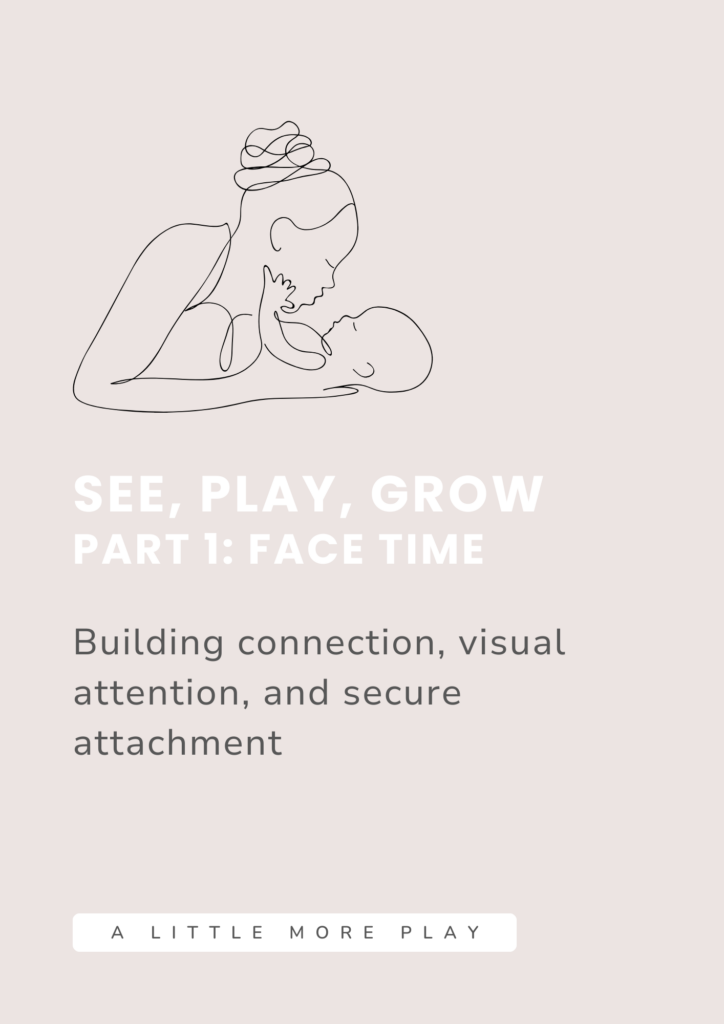
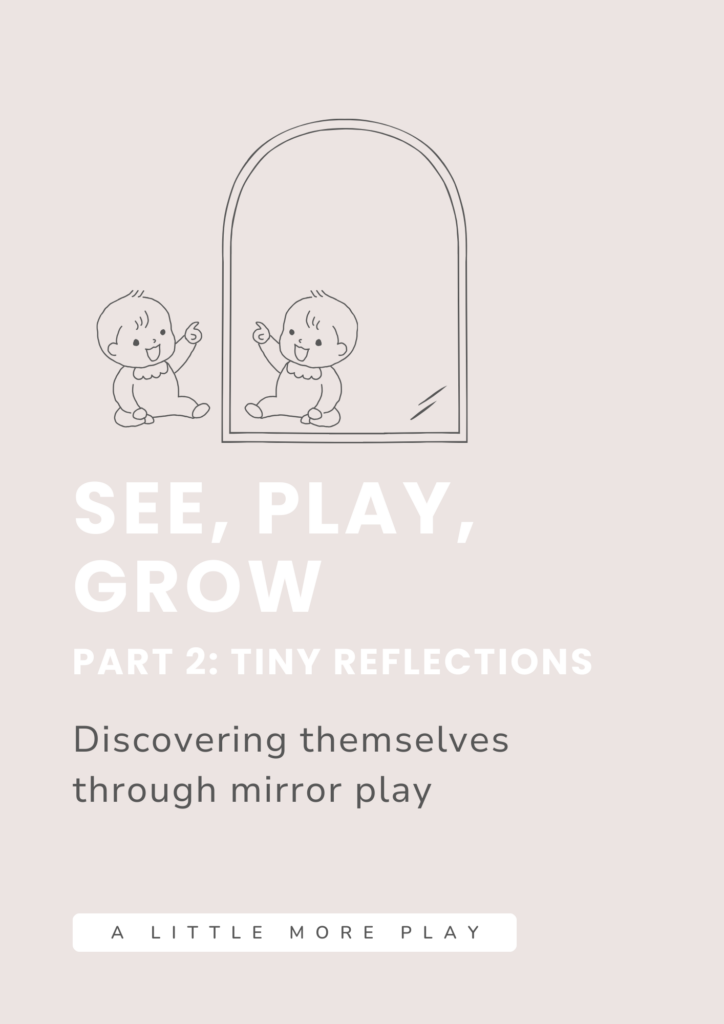
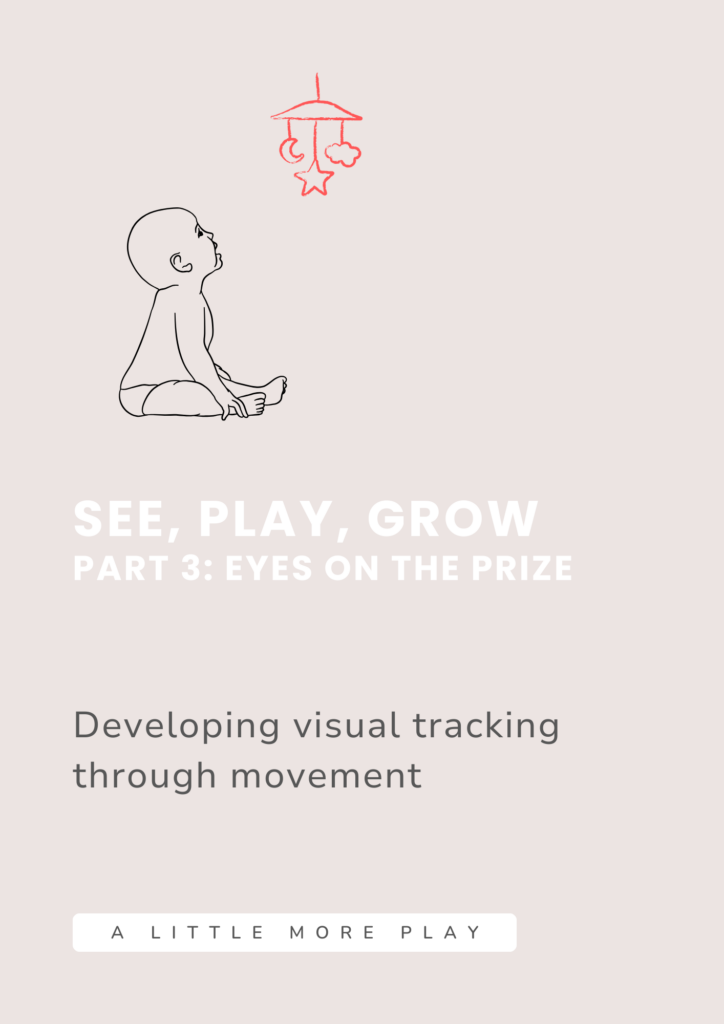
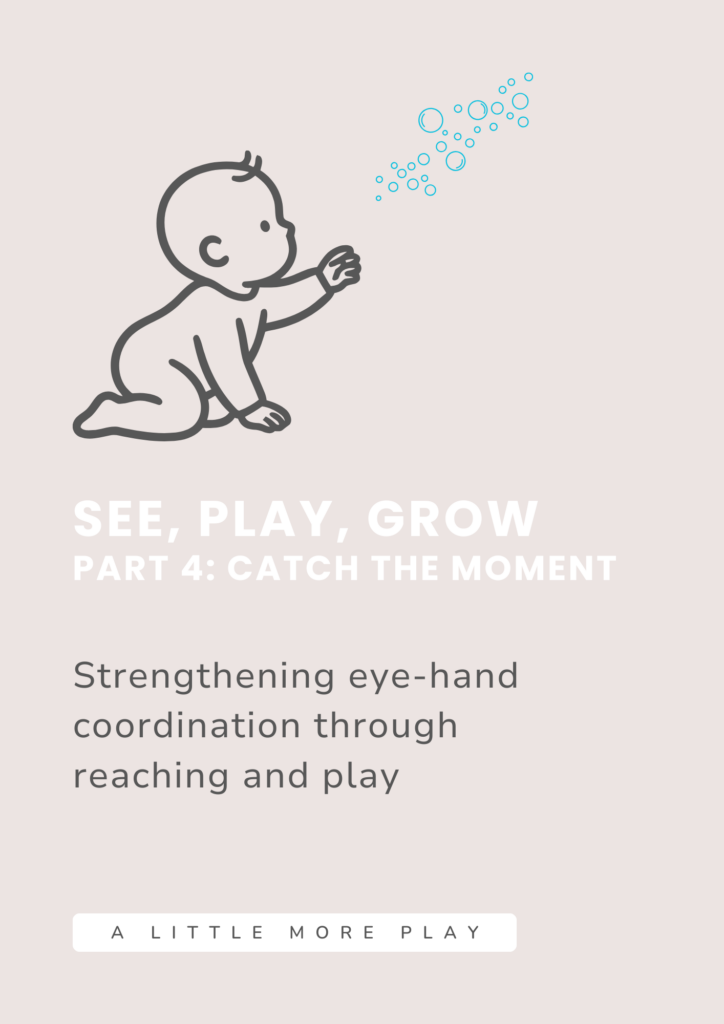
Together, these playful experiences help your baby build the visual foundations they’ll use for years to come.
Part 1: Face to Face
Building Vision Begins with Connection
Long before babies can recognise colours or reach for toys, they are fascinated by one thing:
Your face.
Newborns naturally prefer looking at human faces, especially their caregiver’s face. During those quiet moments of feeding, cuddling, singing, or simply gazing into each other’s eyes, babies are learning far more than who you are.
They’re learning how to focus.
They’re learning to recognise expressions.
They’re beginning to interpret emotions.
They’re discovering that the world is safe and predictable.
These early face-to-face interactions also help build secure attachment—the trusting relationship that develops when caregivers respond consistently and warmly to their baby’s cues. Secure attachment supports emotional regulation, curiosity, confidence, and later learning (Ainsworth, 1978; Bowlby, 1988; Sroufe, 2005).
When babies feel emotionally secure, they’re more willing to explore their surroundings. That exploration fuels cognitive growth because babies learn by moving, observing, experimenting, and interacting with people and objects.
Simple ideas include:
- talking during diaper changes
- smiling while feeding
- copying your baby’s expressions
- singing while maintaining eye contact
- slowly moving your face from side to side
Every shared smile is helping your baby’s brain grow.
Part 2: Tiny Reflections
Mirror Play Builds Body Awareness
One of the most magical moments for babies is discovering the “baby” in the mirror.
At first, they don’t realise they’re looking at themselves.
They simply enjoy the moving face looking back.
Over time, mirror play becomes a powerful tool for developing body awareness, an important foundation for movement and self-understanding.
When babies move an arm and see the reflection move too, they’re beginning to connect what they feel with what they see. This integration strengthens body schema—the brain’s internal map of the body—which supports coordinated movement and motor planning (Ayres, 2005).
Mirror play also encourages:
- visual attention
- head control during tummy time
- social smiling
- early communication
- curiosity
- self-awareness
A floor mirror during tummy time or a shared mirror game while sitting together provides wonderful opportunities for learning.
Part 3: Eyes on the Prize
Following Movement with the Eyes
Imagine trying to read without being able to smoothly follow a line of text.
That’s why visual tracking matters.
Tracking is the ability to smoothly follow moving objects with the eyes while keeping the head relatively still.
During the first year, babies gradually develop this skill by watching faces, toys, bubbles, scarves, balls, or colourful objects move through space.
Tracking helps babies:
- understand movement
- anticipate where objects will go
- develop attention
- coordinate both eyes together
- prepare for later reading skills
Movement makes tracking even more meaningful.
Rather than simply waving toys in front of babies, encourage them to follow objects while they roll, reach, crawl, or change positions.
The brain learns best when vision and movement work together.
Part 4: Catch the Moment
Building Eye-Hand Coordination
Once babies begin reaching intentionally, a whole new world opens.
They no longer just look.
They act.
Eye-hand coordination develops when babies use what they see to guide their hands accurately toward a target.
Every successful reach strengthens communication between the eyes, brain, and muscles.
Activities like:
- reaching for rattles
- grabbing scarves
- transferring toys between hands
- picking up soft blocks
- batting hanging toys
- crawling toward favourite objects
all strengthen visual-motor integration.
These early experiences eventually support writing, dressing, feeding, catching balls, building with blocks, and countless everyday skills later in childhood.
Remember: Development Isn’t a Race
Every baby develops at their own pace.
Some babies spend longer watching.
Others are eager to move.
Some crawl early.
Others skip crawling altogether.
The goal isn’t to rush milestones.
The goal is to provide rich opportunities for connection, movement, exploration, and joyful play.
Small moments, repeated often, build strong brains.
Ready to Play?
The See, Play, Grow Series takes these developmental ideas and turns them into simple, practical activities you can enjoy with your baby from birth through 12 months.
Each guide includes age-appropriate movement experiences, easy play ideas using everyday items, developmental explanations, and practical tips to help you feel confident supporting your baby’s growing visual skills.
Because when babies move, they don’t just build stronger bodies.
They build stronger eyes, stronger brains, stronger relationships—and a lifelong love of learning.
References
- Adolph, K. E., & Hoch, J. E. (2019). Motor development: Embodied, embedded, enculturated, and enabling. Annual Review of Psychology, 70, 141–164.
- Ainsworth, M. D. S. (1978). Patterns of Attachment: A Psychological Study of the Strange Situation. Lawrence Erlbaum.
- American Optometric Association. (2022). Infant Vision: Birth to 24 Months.
- Ayres, A. J. (2005). Sensory Integration and the Child (25th Anniversary ed.). Western Psychological Services.
- Bowlby, J. (1988). A Secure Base: Parent-Child Attachment and Healthy Human Development. Basic Books.
- Piek, J. P., Dawson, L., Smith, L. M., & Gasson, N. (2008). The role of early fine and gross motor development on later motor and cognitive ability. Human Movement Science, 27(5), 668–681.
- Sroufe, L. A. (2005). Attachment and development: A prospective, longitudinal study from birth to adulthood. Attachment & Human Development, 7(4), 349–367.