
Every baby develops in their own way and on their own timeline—but movement is always part of the journey. Below are easy, joyful play activities you can try at home, organized by age and developmental stage.
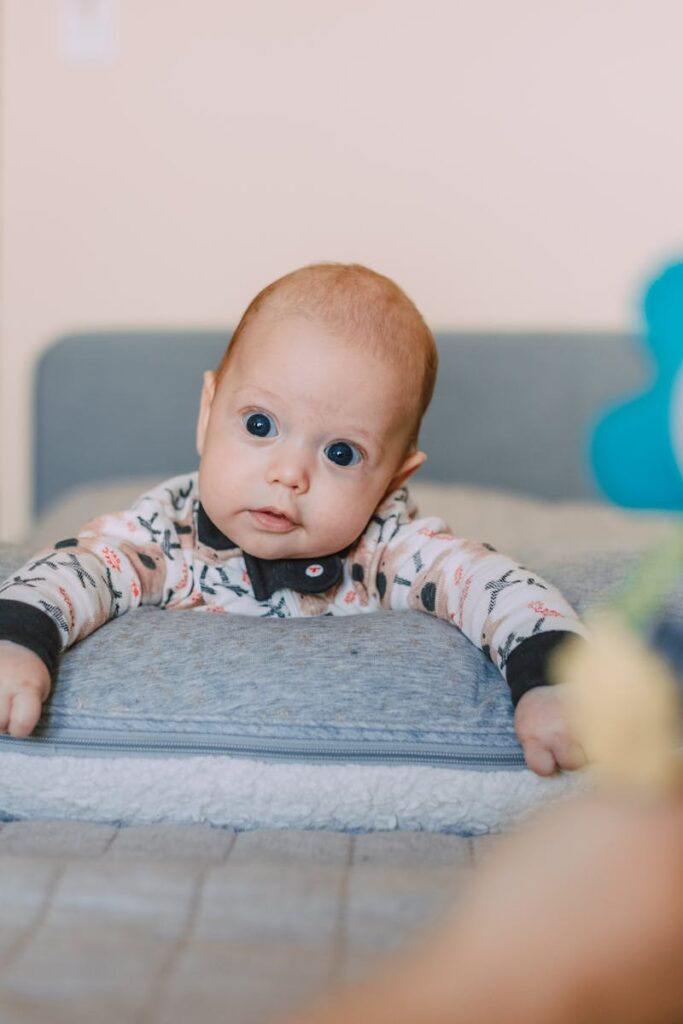
1–4 Months: Head Control & Early Exploration
- Developmental Goals:
- Lifting head during tummy time
- Gaining better head control
- Tracking objects with eyes
- Beginning to reach or swipe
- Try These:
- Gentle Leg Bicycles + Infant Massage
Encourages movement, bonding, and supports digestion. - Tummy Time on Your Chest
Boosts neck strength and connection (AAP, 2022). - High-Contrast Object Tracking
Move a simple black-and-white card side to side; supports visual tracking and early attention (Bortfeld, 2019). - Face-to-Face Talk + Expressions
Hold your baby close and slowly smile, coo, and exaggerate expressions; nurtures early communication and social engagement (Trevarthen, 2001). - Side-Lying Play with a Soft Rattle
Lay baby on their side with a small rattle nearby; encourages reaching, rolling, and midline awareness (Case-Smith et al., 2015)
- Gentle Leg Bicycles + Infant Massage
Safety Tip: Always supervise tummy time and never leave baby unattended on elevated surfaces—stick to floor play for safety.
4–6 Months: Core Strength & Rolling Over
- Developmental Goals:
- Rolling side to side or back to belly
- Holding head steady
- Grasping toys with intent
- Try These:
- Supported Sitting + Reaching
Use a pillow to assist baby in sitting and grasping toys. Builds trunk strength and coordination (Libertus & Violi, 2016). - Rolling Toy Temptation
Place a favorite toy just out of reach—encourages rolling and pivoting. - Mirror Floor Play
Baby sees themselves as they push up during tummy time—great for motivation and self-awareness. - Toe-to-Hand Discovery
Let baby explore their feet during diaper changes or on the floor. Boosts body awareness, flexibility, and core engagement. - Obstacle Scoot + Slide
Create a soft surface with pillows or towels for baby to scoot across. Supports upper body strength, crawling prep, and spatial awareness.
- Supported Sitting + Reaching
Safety Tip: Make sure play spaces are clear of small objects and choking hazards, as babies begin rolling and reaching more confidently.


7–10 Months: Sitting, Crawling & Pulling to Stand
- Developmental Goals:
- Sitting unsupported
- Crawling or scooting
- Starting to pull to stand
- Try These:
- Stand & Bounce with Support
Hold baby upright and bounce to music—fun and builds leg strength. - Soft Obstacle Course
Crawling over cushions or under chairs builds strength, balance, and planning (Adolph & Hoch, 2019). - Toy Basket Dump & Discover
Baby tips a soft bin and explores contents. Great for hand skills and cause-effect learning. - Cruising Along Furniture
Encourage baby to move side-to-side while holding onto a couch or low table. Boosts balance, leg strength, and confidence. - Tunnel Peekaboo
Drape a blanket over chairs to make a tunnel. Baby crawls through while you play peekaboo—supports spatial awareness and motivation to move.
- Stand & Bounce with Support
Safety Tip: As babies start crawling, standing, and cruising, anchor furniture, cover sharp corners, and create a soft, secure play area to prevent falls.
Just 10 Minutes a Day
Play doesn’t have to be long or complicated. Even 10–15 minutes a day of intentional movement-based play can have a huge impact on brain-body development—especially when it’s consistent (Gibbs et al., 2020).
If you want weekly structure, our Playful Foundations Blueprint offers easy-to-follow routines that build on milestones and make play a natural part of your day.
References:
- AAP (2022). Tummy Time for Your Baby. American Academy of Pediatrics.
- Adolph, K.E., & Hoch, J.E. (2019). Motor development: Embodied, embedded, enculturated, and enabling. Annual Review of Psychology, 70, 141–164.
- Bortfeld, H. (2019). Attention and learning in infancy: Foundations for development. Developmental Cognitive Neuroscience, 36, 100637.
- Gibbs, B.G., Forste, R., & Lybbert, E. (2020). Infant play and the development of cognitive and physical skills: A longitudinal analysis. Infant Behavior and Development, 58, 101429.
- Libertus, K., & Violi, D.A. (2016). Sit to talk: Relation between motor skills and language development in infancy. Frontiers in Psychology, 7, 475.