
Ever wonder if all that kicking, rolling, and peekaboo is actually doing anything? Good news: it is. In fact, it’s doing a whole lot.
Let’s break down the science of play in the easiest way possible—no textbook required.
Play = Brain Growth in Action
From birth to age three, your baby’s brain is forming more than a million new neural connections per second (Center on the Developing Child, 2007; Nelson, 2017). And play is one of the most powerful ways to spark that growth. Every time your baby kicks, gazes into your eyes, or reaches for a toy, their brain is building pathways for thinking, moving, and feeling.

Play Builds Emotional Smarts Too
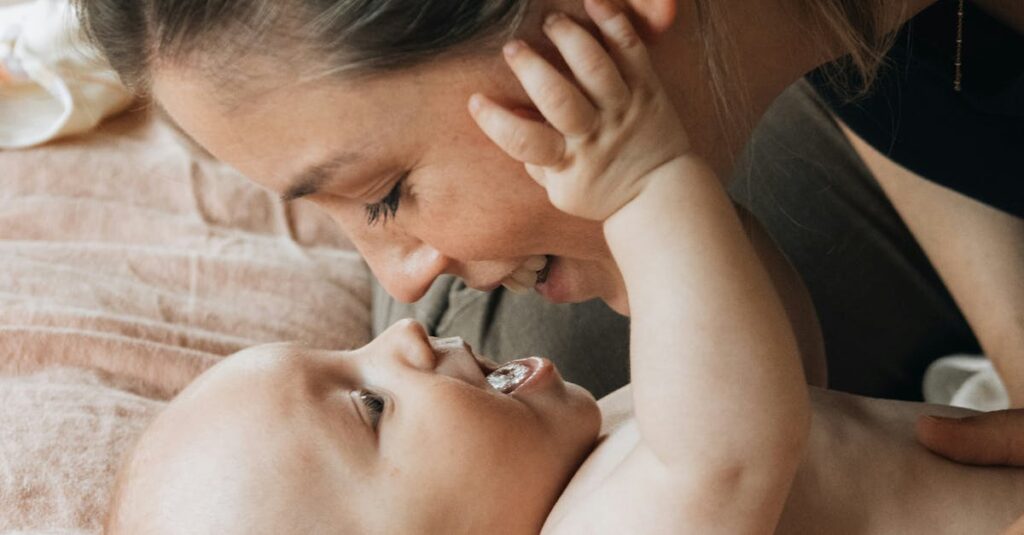
Responsive play—where you mirror your baby’s sounds, smile, and follow their lead—builds a sense of safety and connection. That emotional bond (called secure attachment) shapes everything from emotional regulation to confidence in trying new things (Waters et al., 2020).

The Most Important Toy? You.
Your face. Your voice. Your time. While toys and tools can support development, research consistently shows that a caregiver’s presence and responsiveness are the biggest contributors to brain development in early childhood (Shonkoff & Garner, 2012).
Making Play a Weekly Habit = Big Impact
Routines matter. When play becomes part of your week—just like bedtime stories or family meals—it becomes a ritual of connection. It builds not just skills, but memories and traditions that stick.
Ready to start a simple play rhythm?
Our Playful Foundations Blueprint gives you weekly play ideas rooted in science but delivered with joy.
👉 Need Some ideas for tummy time and beyond? Click here!
References
- Cameron, C.E., Brock, L.L., Murrah, W.M., Bell, L.H., Worzalla, S.L., Grissmer, D., & Morrison, F.J. (2016). Fine motor skills and executive function both contribute to kindergarten achievement. Child Development, 83(4), 1229–1244.
- Center on the Developing Child (2007). The Science of Early Childhood Development. Harvard University.
- Nelson, C.A. (2017). Hazards to early development: The biological embedding of early life adversity. Neuron, 96(2), 262–266.
- Shonkoff, J.P., & Garner, A.S. (2012). The lifelong effects of early childhood adversity and toxic stress. Pediatrics, 129(1), e232–e246.
- Suggate, S.P., Schaughency, E.A., & Stoeger, H. (2019). The role of fine motor skills in the development of executive functions and academic achievement. Early Childhood Research Quarterly, 47, 489–502.
- Waters, S.F., Virmani, E.A., Thompson, R.A., Meyer, S., & Raikes, H.A. (2020). Emotion regulation and attachment: Unpacking two decades of research. Attachment & Human Development, 22(4), 349–370.