
It might look like chaos. One moment your toddler is rolling like a burrito across the living room carpet, the next they’re spinning themselves dizzy, then begging to swing again at the playground (even though your arms are noodles!).
But here’s the beautiful secret: those big, bold, bouncy movements? They’re not just fun—they’re building blocks for your child’s brain (Ayres, 2005).

The Power of Movement in Early Brain Development
From birth to age five, a child’s brain is growing at lightning speed. And one of the biggest fuel sources for that growth? Movement (Jensen, 2005). Especially the kind that activates the vestibular system—the inner ear system responsible for balance, coordination, and spatial awareness (The Inspired Treehouse).
When your toddler spins, swings, or rolls, they’re giving their vestibular system a workout, which strengthens:
- Balance and posture
- Attention and focus (Goddard Blythe, 2005)
- Emotional regulation (Zero to Three)
- Core strength and motor coordination
- Future learning skills like reading and writing (NAEYC)
In other words: spinning = smarter.

Let’s Break Down the Big Three: Spin, Swing, and Roll
Spin
Your toddler might spin until they fall over giggling. It can make you dizzy just watching! But this love of twirling isn’t random—it’s a natural way for them to regulate their nervous system and fine-tune balance (Ayres, 2005).
Try This:
- Turn on music and play “Spin and Freeze.”
- Use a swivel chair (supervised!) for a controlled spin.
Why it helps: Activates the inner ear, builds spatial awareness, and helps develop a sense of body control.
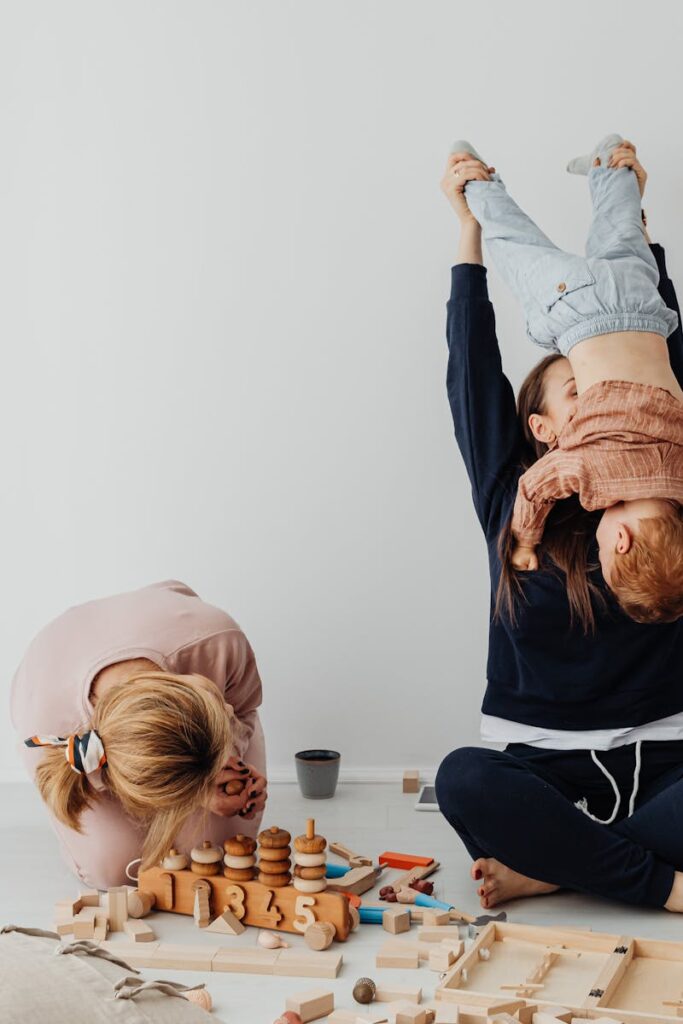
Swing
There’s a reason toddlers want to swing for ages. The rhythmic back-and-forth is incredibly soothing to their nervous systems (The Inspired Treehouse).
Try This:
- Offer both front-to-back and side-to-side swings.
- Try a blanket swing indoors (two adults holding each side).
Why it helps: Supports sensory integration, calms overstimulation, and helps with attention and mood (Zero to Three).

Roll
Whether they’re log-rolling down a hill or across your bed, toddlers love the full-body feedback rolling gives.
Try This:
- Roll down soft hills or grassy slopes.
- Create a “rolling lane” with blankets and cushions.
Why it helps: Builds core strength, coordination, and stimulates both sides of the brain (hello, future reading!) (CDC).
Everyday Movement = Everyday Brain Gains
You don’t need fancy equipment to support your toddler’s brain-building moves. Just a safe space to move, time to explore, and permission to wiggle, wobble, and be wonderfully wild (Perry & Szalavitz, 2017).
Ideas to encourage movement-rich play:
- Set up a “movement circuit” at home: roll, spin, jump, repeat
- Let your child move before seated tasks like meals or stories
- Say yes to puddle jumping, couch cushion tumbling, and backyard obstacle courses

Final Thoughts: Trust the Wiggles
It’s easy to feel like your toddler’s constant movement is exhausting (because let’s be honest—it is). But that instinct to move, spin, and roll is actually nature’s way of building a better brain (Harvard Center on the Developing Child).
So the next time your little one is twirling like a top or turning your sofa into a gymnastics mat, take a breath and smile. They’re not just playing. They’re wiring their brain, strengthening their body, and learning how to be in the world.
Play on, little mover. You’ve got a brain to build.
References:
- Perry, B. D., & Szalavitz, M. (2017). The Boy Who Was Raised as a Dog. Basic Books.
- Goddard Blythe, S. (2005). The Well Balanced Child: Movement and Early Learning. Hawthorn Press.
- Ayres, A. J. (2005). Sensory Integration and the Child. Western Psychological Services.
- Jensen, E. (2005). Teaching with the Brain in Mind. ASCD.
- Centers for Disease Control and Prevention (CDC). Child Development Milestones
- Zero to Three. Early Development & Well-Being
- Harvard Center on the Developing Child. Serve and Return
- The Inspired Treehouse. Vestibular Input and Sensory Processing
- NAEYC. The Power of Movement in Early Learning