
There’s a certain magic in watching a toddler figure out how to climb a couch, stack blocks, or wobble-run across a grassy park. These everyday moments aren’t just adorable—they’re vital. They are the foundation of how a young child builds their body, their brain, and even their emotional intelligence. In today’s fast-paced world, screens can sneak in as an easy solution to entertain or soothe—but what do they quietly replace? Movement. And that trade-off comes at a cost.

The Infant Brain: Wired for Human Connection
In the earliest months and years of life, a baby’s brain is developing at a stunning rate—more than a million new neural connections form every second (Center on the Developing Child at Harvard University, 2023). During this time, the infant’s greatest need isn’t digital stimulation—it’s human interaction.
A baby’s primary way of learning is through the faces, voices, and touch of caregivers. Recognizing facial expressions and responding to subtle cues builds the foundation for communication, empathy, and self-regulation (Zeamer et al., 2014). When an infant looks into their caregiver’s face and sees joy, surprise, or calm, their brain lights up. This back-and-forth interaction, often called “serve and return,” lays the groundwork for social and emotional development.
Screens can’t replicate that. In fact, infants exposed to screens may show reduced attention to human faces and less responsiveness to social cues (Christakis, 2009). That’s why the World Health Organization recommends zero screen time for children under 2 years old—not just limited, but zero (WHO, 2019). Not because screens are inherently evil, but because they displace something better: eye contact, facial mimicry, giggles, peek-a-boo, and movement.
Toddlers: Movement as the Master Teacher
As infants grow into toddlers, their primary learning tool becomes movement. Whether they’re crawling, cruising, climbing, or tumbling, toddlers are mapping the world—and their brains—through physical activity.
Motor development is deeply connected to brain development. When toddlers move, they are building balance, coordination, spatial awareness, and even early math and literacy skills. A child stacking blocks learns about gravity and geometry. A child jumping off a log learns about risk and resilience. These aren’t just cute moments; they’re neurodevelopmental goldmines.
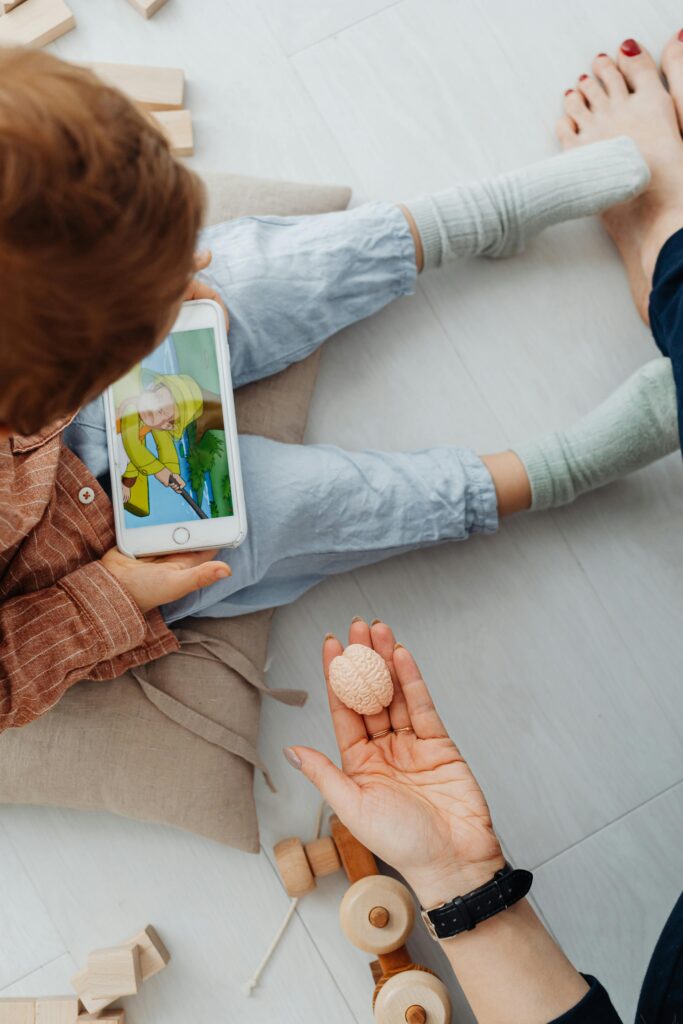
Excessive screen time at this age not only displaces movement but often shortens attention spans and lowers opportunities for imaginative play—both of which are crucial for healthy cognitive growth (Pagani et al., 2019). A toddler watching a screen is still and passive, whereas a toddler engaged in play is active and connected to their body and environment.

But Everyone Else is Doing It…
If you’re a parent feeling the tension, you’re not alone. We live in a world that makes screen exposure almost inevitable. Whether it’s a phone at the dinner table, a tablet in the car, or a “quick fix” while you make dinner, screens are part of modern life. But knowing what’s at stake helps us make more intentional choices.
Movement and the Rise of Attention Challenges
There’s growing concern about how early screen exposure may relate to attention difficulties, including ADHD. While ADHD is complex and not caused by one single factor, studies are showing correlations between increased screen time in early childhood and a higher risk of attentional issues later on (Tamana et al., 2019).
At the same time, we’re seeing a cultural decline in the amount of free movement and outdoor play that children get daily. The body was designed to move. When movement is reduced, especially in the early years, it impacts everything—from sensory integration to the development of the prefrontal cortex (responsible for impulse control and executive functioning).
When we replace movement with screen time, we may be priming young brains for shorter attention spans, poor emotional regulation, and learning challenges. While the research is still unfolding, the pattern is becoming harder to ignore.
So What Can We Do?
You don’t need to move to a forest or give up all tech to make a difference. Here are a few small shifts that matter:
- Prioritize face-to-face time: Hold your baby. Make silly faces. Respond to their coos. It all counts.
- Create space for movement: Even a clear corner of the living room with a few cushions can become a toddler’s obstacle course.
- Delay screens: The longer you can delay introducing screens, the easier it is to build healthy habits.
- Model movement: Kids who see their parents stretch, dance, or play are more likely to do the same.
- Invite play often: It doesn’t need to be fancy. Toddlers thrive on repetition and exploration—rocks, spoons, stairs, and puddles are all wonderful teachers.
Final Thoughts
This isn’t about guilt. It’s about empowerment. The early years are fleeting, but the brain wiring that happens during them lasts a lifetime. By choosing movement over screens whenever we can, we’re not just filling time—we’re building brains, relationships, and resilient little humans who are ready to explore the world, one step (or tumble) at a time.
References:
- Center on the Developing Child at Harvard University (2023). Brain Architecture. https://developingchild.harvard.edu/science/key-concepts/brain-architecture/
- Zeamer, A., et al. (2014). Face processing in infants and the role of facial expressions. Developmental Psychobiology.
- Christakis, D. A. (2009). The effects of infant media usage: what do we know and what should we learn? Acta Paediatrica.
- World Health Organization (WHO). (2019). Guidelines on physical activity, sedentary behaviour and sleep for children under 5 years of age.
- Pagani, L. S., et al. (2019). Prospective associations between screen time and academic performance in preschool children. Pediatrics.
- Tamana, S. K., et al. (2019). Screen-time is associated with inattention problems in preschoolers: Results from the CHILD birth cohort study. PLOS ONE.